 Add to Chrome
 Add to Firefox
 Add to Edge
EvoCode-Bench: Evaluating Coding Agents in Multi-Turn Iterative Interactions
May 22, 2026
Coding agents are increasingly used as iterative development partners, but most benchmarks still evaluate one specification followed by one final assessment. This leaves out a basic question: can an agent keep its own codebase working as requirements change? We introduce EvoCode-Bench, a benchmark of 26 stateful coding tasks and 227 evaluated rounds. Each task preserves the agent's workspace for 5-15 rounds, states requirements through observable behavior, and uses cumulative executable tests to check new requirements and still-active prior ones. We evaluate 13 coding agents with two metrics: MT@4, a four-attempt fail-stop multi-round score, and SR, a single-round score from a reference-completed prior state. For most agents, SR exceeds MT@4 by 22-40 points. The gap also changes rankings: the highest-SR agent (78.9) ranks only third in persistent execution (44.0 MT@4). Even the strongest agents achieve only about 50% success on multi-turn metrics, and aggregate pass rate drops below half of round-1 performance by round 5. Failure analysis shows tier-dependent behavior: weaker agents fail early, while stronger agents survive long enough to expose specification-tracking and regression failures. We release the benchmark data and Harbor multi-turn infrastructure.

ROMER: Expert Replacement and Router Calibration for Robust MoE LLMs on Analog Compute-in-Memory Systems
May 12, 2026Large language models (LLMs) with mixture-of-experts (MoE) architectures achieve remarkable scalability by sparsely activating a subset of experts per token, yet their frequent expert switching creates memory bandwidth bottlenecks that compute-in-memory (CIM) architectures are well-suited to mitigate. However, analog CIM systems suffer from inherent hardware imperfections that perturb stored weights, and its negative impact on MoE-based LLMs in noisy CIM environments remains unexplored. In this work, we present the first systematic investigation of MoE-based LLMs under noise model calibrated with real chip measurements, revealing that hardware noise critically disrupts expert load balance and renders clean-trained routing decisions consistently suboptimal. Based on these findings, we propose ROMER, a post-training calibration framework that (1) replaces underactivated experts with high-frequency ones to restore load balance, and (2) recalibrates router logits via percentile-based normalization to stabilize routing under noise. Extensive experiments across multiple benchmarks demonstrate that ROMER achieves up to 58.6\%, 58.8\%, and 59.8\% reduction in perplexity under real-chip noise conditions for DeepSeek-MoE, Qwen-MoE, and OLMoE, respectively, establishing its effectiveness and generalizability across diverse MoE architectures.
ClawBench: Can AI Agents Complete Everyday Online Tasks?
Apr 09, 2026AI agents may be able to automate your inbox, but can they automate other routine aspects of your life? Everyday online tasks offer a realistic yet unsolved testbed for evaluating the next generation of AI agents. To this end, we introduce ClawBench, an evaluation framework of 153 simple tasks that people need to accomplish regularly in their lives and work, spanning 144 live platforms across 15 categories, from completing purchases and booking appointments to submitting job applications. These tasks require demanding capabilities beyond existing benchmarks, such as obtaining relevant information from user-provided documents, navigating multi-step workflows across diverse platforms, and write-heavy operations like filling in many detailed forms correctly. Unlike existing benchmarks that evaluate agents in offline sandboxes with static pages, ClawBench operates on production websites, preserving the full complexity, dynamic nature, and challenges of real-world web interaction. A lightweight interception layer captures and blocks only the final submission request, ensuring safe evaluation without real-world side effects. Our evaluations of 7 frontier models show that both proprietary and open-source models can complete only a small portion of these tasks. For example, Claude Sonnet 4.6 achieves only 33.3%. Progress on ClawBench brings us closer to AI agents that can function as reliable general-purpose assistants.
Beyond Outliers: A Data-Free Layer-wise Mixed-Precision Quantization Approach Driven by Numerical and Structural Dual-Sensitivity
Mar 18, 2026Layer-wise mixed-precision quantization (LMPQ) enables effective compression under extreme low-bit settings by allocating higher precision to sensitive layers. However, existing methods typically treat all intra-layer weight modules uniformly and rely on a single numerical property when estimating sensitivity, overlooking their distinct operational roles and structural characteristics. To address this, we propose NSDS, a novel calibration-free LMPQ framework driven by Numerical and Structural Dual-Sensitivity. Specifically, it first mechanistically decomposes each layer into distinct operational roles and quantifies their sensitivity from both numerical and structural perspectives. These dual-aspect scores are then aggregated into a unified layer-wise metric through a robust aggregation scheme based on MAD-Sigmoid and Soft-OR to guide bit allocation. Extensive experiments demonstrate that NSDS consistently achieves superior performance compared to various baselines across diverse models and downstream tasks, without relying on any calibration data.
BabyVision: Visual Reasoning Beyond Language
Jan 10, 2026While humans develop core visual skills long before acquiring language, contemporary Multimodal LLMs (MLLMs) still rely heavily on linguistic priors to compensate for their fragile visual understanding. We uncovered a crucial fact: state-of-the-art MLLMs consistently fail on basic visual tasks that humans, even 3-year-olds, can solve effortlessly. To systematically investigate this gap, we introduce BabyVision, a benchmark designed to assess core visual abilities independent of linguistic knowledge for MLLMs. BabyVision spans a wide range of tasks, with 388 items divided into 22 subclasses across four key categories. Empirical results and human evaluation reveal that leading MLLMs perform significantly below human baselines. Gemini3-Pro-Preview scores 49.7, lagging behind 6-year-old humans and falling well behind the average adult score of 94.1. These results show despite excelling in knowledge-heavy evaluations, current MLLMs still lack fundamental visual primitives. Progress in BabyVision represents a step toward human-level visual perception and reasoning capabilities. We also explore solving visual reasoning with generation models by proposing BabyVision-Gen and automatic evaluation toolkit. Our code and benchmark data are released at https://github.com/UniPat-AI/BabyVision for reproduction.
LongEmotion: Measuring Emotional Intelligence of Large Language Models in Long-Context Interaction
Sep 09, 2025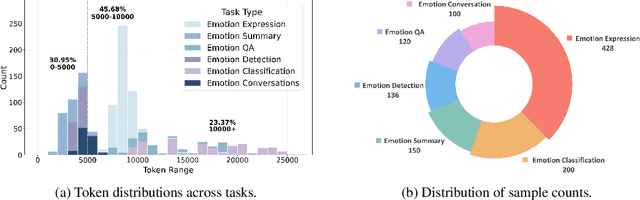
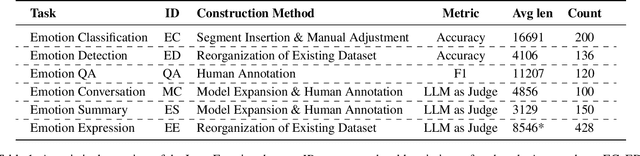
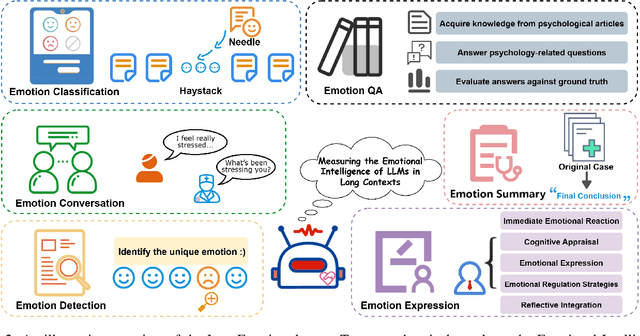
Large language models (LLMs) make significant progress in Emotional Intelligence (EI) and long-context understanding. However, existing benchmarks tend to overlook certain aspects of EI in long-context scenarios, especially under realistic, practical settings where interactions are lengthy, diverse, and often noisy. To move towards such realistic settings, we present LongEmotion, a benchmark specifically designed for long-context EI tasks. It covers a diverse set of tasks, including Emotion Classification, Emotion Detection, Emotion QA, Emotion Conversation, Emotion Summary, and Emotion Expression. On average, the input length for these tasks reaches 8,777 tokens, with long-form generation required for Emotion Expression. To enhance performance under realistic constraints, we incorporate Retrieval-Augmented Generation (RAG) and Collaborative Emotional Modeling (CoEM), and compare them with standard prompt-based methods. Unlike conventional approaches, our RAG method leverages both the conversation context and the large language model itself as retrieval sources, avoiding reliance on external knowledge bases. The CoEM method further improves performance by decomposing the task into five stages, integrating both retrieval augmentation and limited knowledge injection. Experimental results show that both RAG and CoEM consistently enhance EI-related performance across most long-context tasks, advancing LLMs toward more practical and real-world EI applications. Furthermore, we conducted a comparative case study experiment on the GPT series to demonstrate the differences among various models in terms of EI. Code is available on GitHub at https://github.com/LongEmotion/LongEmotion, and the project page can be found at https://longemotion.github.io/.
SwingArena: Competitive Programming Arena for Long-context GitHub Issue Solving
May 29, 2025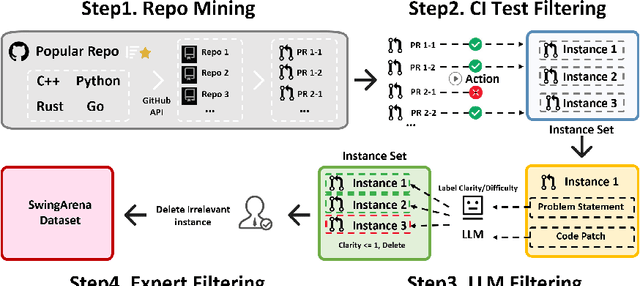
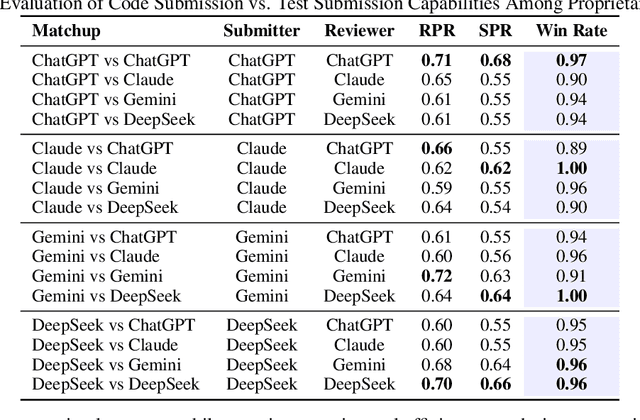
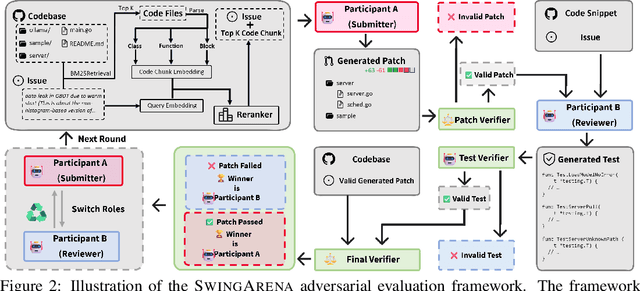
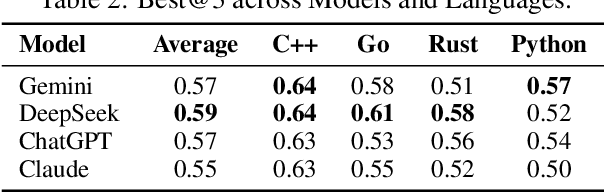
We present SwingArena, a competitive evaluation framework for Large Language Models (LLMs) that closely mirrors real-world software development workflows. Unlike traditional static benchmarks, SwingArena models the collaborative process of software iteration by pairing LLMs as submitters, who generate patches, and reviewers, who create test cases and verify the patches through continuous integration (CI) pipelines. To support these interactive evaluations, we introduce a retrieval-augmented code generation (RACG) module that efficiently handles long-context challenges by providing syntactically and semantically relevant code snippets from large codebases, supporting multiple programming languages (C++, Python, Rust, and Go). This enables the framework to scale across diverse tasks and contexts while respecting token limitations. Our experiments, using over 400 high-quality real-world GitHub issues selected from a pool of 2,300 issues, show that models like GPT-4o excel at aggressive patch generation, whereas DeepSeek and Gemini prioritize correctness in CI validation. SwingArena presents a scalable and extensible methodology for evaluating LLMs in realistic, CI-driven software development settings. More details are available on our project page: swing-bench.github.io
PhyX: Does Your Model Have the "Wits" for Physical Reasoning?
May 21, 2025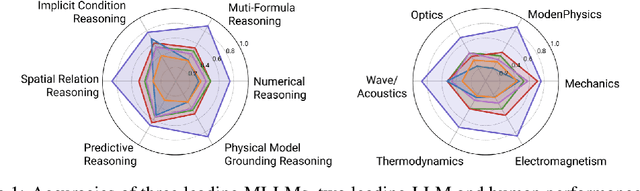
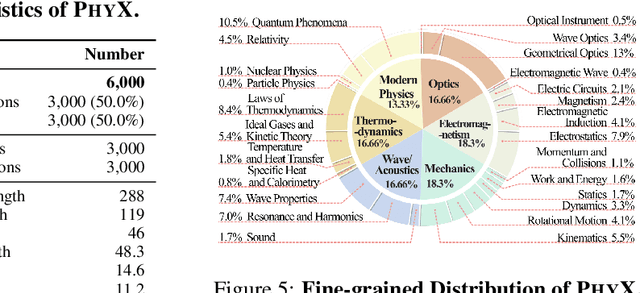
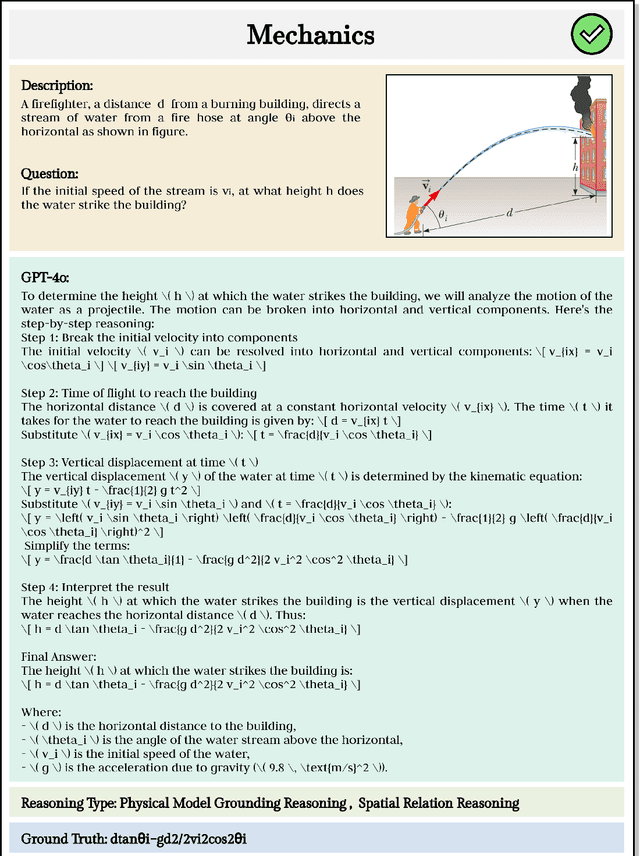
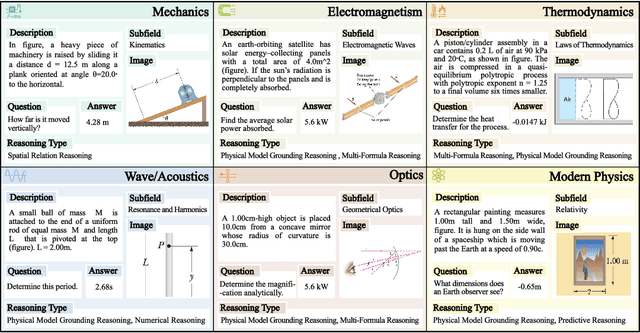
Existing benchmarks fail to capture a crucial aspect of intelligence: physical reasoning, the integrated ability to combine domain knowledge, symbolic reasoning, and understanding of real-world constraints. To address this gap, we introduce PhyX: the first large-scale benchmark designed to assess models capacity for physics-grounded reasoning in visual scenarios. PhyX includes 3K meticulously curated multimodal questions spanning 6 reasoning types across 25 sub-domains and 6 core physics domains: thermodynamics, electromagnetism, mechanics, modern physics, optics, and wave\&acoustics. In our comprehensive evaluation, even state-of-the-art models struggle significantly with physical reasoning. GPT-4o, Claude3.7-Sonnet, and GPT-o4-mini achieve only 32.5\%, 42.2\%, and 45.8\% accuracy respectively-performance gaps exceeding 29\% compared to human experts. Our analysis exposes critical limitations in current models: over-reliance on memorized disciplinary knowledge, excessive dependence on mathematical formulations, and surface-level visual pattern matching rather than genuine physical understanding. We provide in-depth analysis through fine-grained statistics, detailed case studies, and multiple evaluation paradigms to thoroughly examine physical reasoning capabilities. To ensure reproducibility, we implement a compatible evaluation protocol based on widely-used toolkits such as VLMEvalKit, enabling one-click evaluation.